Introduction to Jocelyn Clarke's work, for her solo exhibition at the Jerwood Space, London, 25th June - 20th July 2003
by Sacha Craddock
Look hard at these paintings to almost hear sporadic patches of life, partial
silence, then talking in the street as a couple walks by. But
then the relationship between place, life and painting became
somewhat over done and over stated years ago. Artists apparently
stopped all that anecdotal stuff. It would anyway be an
insulting cliché to suggest that a woman, especially a
woman who works at home, is therefore dealing with the situation
at home. These paintings are no illustration of life. But there
is something fascinating, however, about the relation between
work, place and subject. As a painter working now, Jocelyn
Clarke is highly qualified to understand the powerlessness of
any direct claim to subject. Her pursuit as an artist has anyway
always been discrete.
'What is it of?' they ask. But it is not really of anything. Still life is the
ultimate Modernist genre. There is no actual subject to still
life unless of course you are the art historian seeking
symbolism, the botanist mourning the passing of a species, or
the chemist checking the pigment. As well as the reaction to the
grand subject, the cups, saucers, cloths and table corners of
Cubist painting are about a formal investment in something to
say. Morandi painted the same ledge, the same space
outside, the same bottles inside, repeatedly. He wanted the
paint itself to make life exist, to bring something separate to
life. So his paintings may not have been strictly striving in
terms of subject but they do carry the urgent compulsion to
record in time and with time. A strange and separate process, a
sort of mindful mindlessness about Morandi's repetitive
compulsion produced work which is nonetheless a truly powerful
vessel of atmosphere.
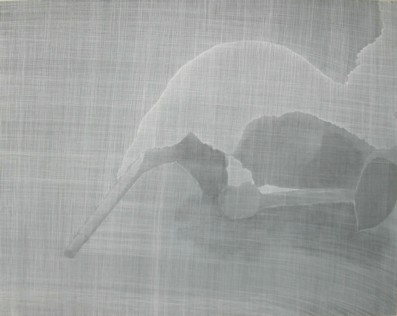
Despite the Snow 2003 61 x 71 cm acrylic on canvas
Everything in
Clarke's paintings is covered or cloaked. The surface is
extended and distended across the whole illusion till it seems
the image is somehow submerged beneath the familiar covering of
interior and exterior; a bed-cover, fall of
snow, roller blind, or carpet. The paint
itself covers the canvas, claiming territory but the point is
further cloaked by a layer of muffled understanding. This whole
relation between what is seen and what is there in that very
corner, for instance, is caught perpetually for an extended
second. 'Why is that there?' the artist asks, as if seeing it
for the first time, as if within a normal continuous process of
holding something still, Clarke is hoping for something to speak
back. For a number of years she has extended this somewhat
hands-off observational process by using a video camera. The
stills of something so very familiar provide a sense of wonder
at what is already there as well as an unwittingly vivid memory.
The relationship between the covering and cloaking and the
actuality of life is interesting. Not unlike brass or pavement
rubbings they recall that exact moment when an artist discovers
that beauty and possibility lie very close, just about
everywhere in just about everything.
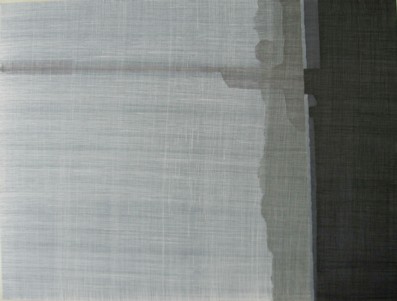
Window 2002 61 x 71 cm acrylic on canvas
The painting process
is intensive. Small strokes mesh together to weave a fabric of
sight. The paint is moved across the surface by fine brush
making fines line and the effect for both artist and viewer is a
sort of halfway-house of before and after vision. The artist
works from the ground of the canvas to build understanding.
Everybody else stands on the other side and tries to make sense
of imagery that looks restrained, and held back, and appears to
have been there in the first place. The relationship to
photography and film is strong.
At least two layers
of language are being used; by drawing across the surface like
this Clarke places the whole practice and pursuit outside any
striving for expressive composition. It is impossible for Clarke
to 'go back into a painting' in order to make it say more. The
process is total, mapped out in its complexity. The first layer
of structure, the build up of fine lines, make this almost an
artisanial play which mimics the duty of domestic work in
another era. Polishing the silver, cleaning the step, rubbing
away until the metaphor comes amazingly close and full circle.
The Edwardian sense of the interior is mirrored in Clarke's
affinity with the tonally muted found footage of the early work
of Douglas Gordon with its play on an ambiguous relationship between art-work and documentation.
With almost parental care, Clarke pushes the work to be on its own and truly
independent. She separates herself from the outcome. The
paintings look as if they have either been found ready-made or
at least charmed into existence by the artist through an
intensive restorative process. Caught in a state, both
intelligent and automatically unknowing, the artist here does
not really want to express much at all. As a result the work
looks as if it just had to be made and is not the result of an
expressive need to shift direction and make sudden decisions.
This has a lot to do with print and photography. The whole
component of imagery carries the integral relation to
photography that has been part of all painting since Daguerre. The warp and weft of manufactured
image, the possibility of print, the look of the early
photograph with muted colour tipped in, builds up a mass of
detail making an all-over image. The all-over painting holds
tension within a language that carries also a sense of finding
something that is already known. Sound and vivid memory are
stored not so much in the selection and execution of the image
itself but also in the atmosphere that surrounds its making.
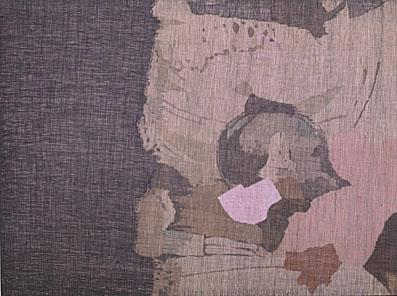
Five O'Clock Sunday 2000 46 x 61 cm acrylic on canvas
The almost
un-definable image of a snowy corner just there outside carries
with it that ennui, the tired recognition of the familiar seen
through the half-light at a particular time of day. Clarke is even interested in what she
calls 'dreary' non-descript light. Much of Clarke's painting has
light against dark, a kind of negative/ positive play
reminiscent of the photographic negative. Looking through the
drawn transparent blind towards the light, the paintings look
light-sensitive and remind also, at a really simple level, of
wallpaper which seems faded in contrast to the darker patch left
by a picture removed after a very long time. Swing has the image sitting
out there, cloaked. We are trying to understand it but at a
certain point comprehension mixes so unconsciously with other
forms of two-dimensional representation that the structure, at
least, holds together and the mind is reminded not to ask.
Etching, engraving and academic drawing have the same result.
The thin line brought across the surface till an apparently
natural break means also a disjointed relationship to outline.
Clarke delineates through the infinite build up of method,
making the end of something abut with something else to play an
equal game.

Swing 2000 46 x 56 cm acrylic on canvas
The faint colouring seems to come from the back, to just about hold and at certain
points, at the edge, for instance, the drawing reaches a greater
intensity. Look at La Toilette 1862, by Manet in the Courtauld and the
hatching of the ground illuminates the figure of the woman who
projects, naturally as the subject, forward from the front.
Other randomly chosen pieces from the Courtauld collection;
Summer, 1570, an engraving by Pieter Van de Heyden, after
Pieter Breugel the Elder, and William Hogarth's Etching The Bruiser, show how automatically and for how
long, the eye has been trained to construct a picture, any
picture, whether printed or first hand. To a very simple extent
pixilation, pointillism and cross-hatching also achieve the same
result. It is hardly surprising that Jocelyn Clarke, a
contemporary painter, uses, consciously and unconsciously, every
method of two-dimensional reproduction to say what she has to
say.
Sacha Craddock is a writer and critic based in London and chair of New
Contemporaries
• back to top of page